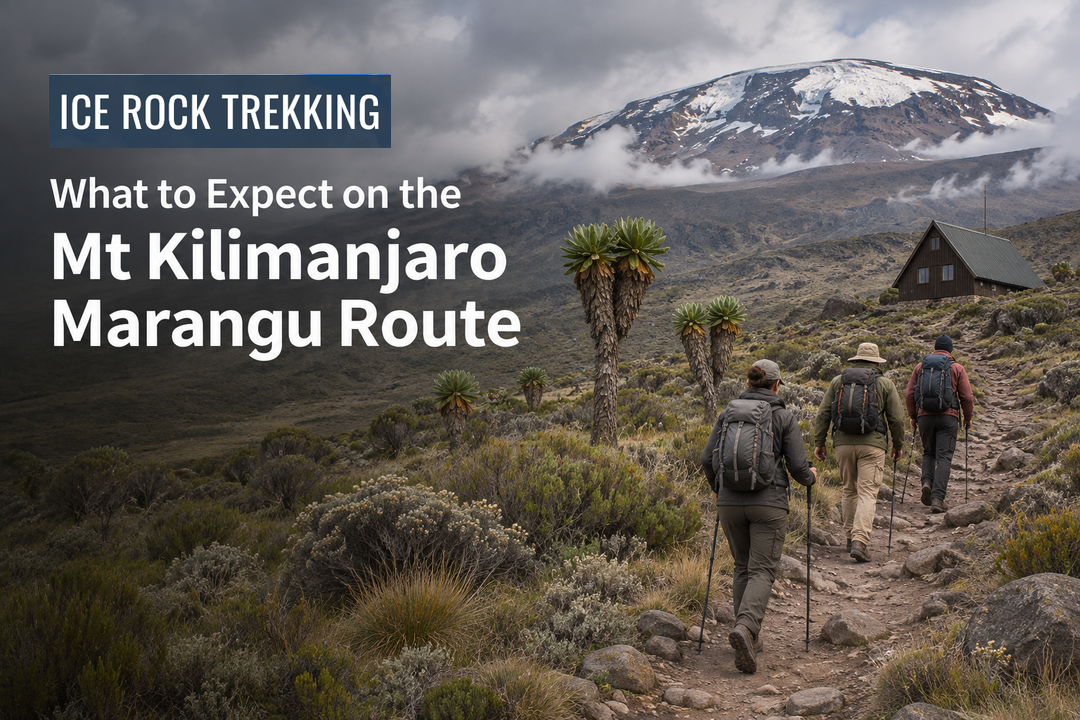
On Kilimanjaro’s Marangu Route, you walk from rainforest to alpine desert, sleep in shared mountain huts and make a night ascent towards Uhuru Peak, Tanzania’s highest point at 5,895 metres. Most itineraries take five or six days on the mountain. If you’re comparing mt kilimanjaro marangu route itineraries, look for a second night at Horombo Hut. It gives you another day to adjust to altitude before you cross the exposed Saddle to Kibo Hut. The section from Kibo to the summit is steep, cold and followed by several more hours of descent.
How the Marangu Route climbs Kilimanjaro
The route starts and finishes at Marangu Gate, east of Moshi in northern Tanzania. You climb through Mandara, Horombo and Kibo huts, then retrace the main trail after your summit attempt, spending your final night at Horombo. You’ll see some of the same scenery twice, often in different light and at a different pace. On the way down, you may have more time to notice the giant groundsels in the moorland or hear birds in the forest.
Marangu’s reputation for gentle gradients comes partly from its opening stages. The forest path and moorland trail allow you to find a rhythm. Above Kibo Hut, loose volcanic rock shifts underfoot, and the trail climbs in tight bends. If you’re comparing Marangu with a tent-based route, weigh the appeal of a bunk against the time each schedule gives you to adjust to higher sleeping elevations.
What the six-day Marangu itinerary looks like
Day 1 — Marangu Gate to Mandara Hut
After park registration, you enter a montane forest where the canopy keeps much of the trail shaded. In damp weather, rain and mud can slow the walk. Most groups reach Mandara Hut, at roughly 2,700 metres, after four to five hours. Set an easy pace from the gate so you have enough breath to talk comfortably as the path climbs.
If you arrive with time and the weather is clear, ask your trekking leader about the short walk to Maundi Crater. From the rim, breaks in the cloud may open views towards the plains and lakes below. Back at Mandara, get your morning layers and water ready before you settle into the bunkroom.
Day 2 — Mandara Hut to Horombo Hut
The trees thin as the trail enters heath and moorland. You’ll walk across open slopes and dip into shallow valleys, where giant groundsels stand above the surrounding vegetation. In clear weather, the jagged peaks of Mawenzi may come into view. Keep a windproof layer where you can reach it as you leave the forest.
Horombo Hut sits at about 3,720 metres, roughly 1,000 metres above Mandara. That jump in sleeping elevation is more significant than the walking time alone suggests. Allow around five to six hours on the trail, with time to slow down and take breaks. Tell your trekking leader how you feel when you reach the hut and again if anything changes later in the evening.
Day 3 — Acclimatisation at Horombo Hut
A six-day itinerary usually leaves you at Horombo for a second night. If everyone feels well and conditions allow, the trekking team may lead a short walk towards Zebra Rocks, named for their pale and dark bands. You gain a little height on foot, then come back down to eat and sleep at Horombo.
The shorter outing leaves time to dry clothes, reorganise your daypack and check your headtorch before the upper mountain. A five-day itinerary typically skips this day and continues directly from Horombo to Kibo after one night. When you compare itineraries, count the trekking days from gate to gate. Airport transfers and nights in town can make two trips seem equally long even when their mountain schedules differ.
Day 4 — Horombo Hut to Kibo Hut
The climb to Kibo Hut crosses the Saddle, the broad expanse between Mawenzi and Kibo. Vegetation grows sparse, and the open ground gives you little shelter from sun or wind. A steady gradient can feel slow at this altitude. Keep water and a snack close so you can use short breaks to drink and eat without unpacking everything.
Kibo Hut stands at roughly 4,700 metres. You may arrive in the afternoon, eat early and try to rest before the night departure. Lay out your gloves, insulating layers and the snacks you’ll carry uphill before getting into your sleeping bag. Find out when your group will wake up, where you’ll meet and which belongings you can leave at the hut for collection on the descent.
Day 5 — Kibo Hut to Uhuru Peak and down to Horombo
Many groups leave Kibo around midnight. Your headtorch lights only a small stretch of trail, and the group often settles into short, deliberate steps. The path climbs past Hans Meyer Cave, then zigzags up loose scree to Gilman’s Point on the crater rim. You’ll have gained nearly 1,000 metres since leaving Kibo. Uhuru Peak lies farther along the rim, where wind and cold can make even gentle sections feel demanding.
After the summit attempt, you descend the same slope to Kibo Hut. There’s usually a short break to eat, drink and collect your kit before you continue across the Saddle to Horombo. This is usually your longest day on the mountain. If you train only for the uphill effort, the afternoon descent can catch you out. Trekking poles and footwear you’ve already used on loose downhill trails can make that section easier to manage.
Day 6 — Horombo Hut to Marangu Gate
The final day takes you from open moorland back into the forest, passing Mandara Hut on the way to the gate. As the air grows warmer, you’ll probably shed layers. Keep your waterproofs accessible. The lower trail can become slippery after rain, especially late in the walk when tired legs make precise foot placement harder. At Marangu Gate, you sign out before continuing to your onward transfer.
What the Marangu huts offer
Kilimanjaro National Park provides sleeping huts at Mandara, Horombo and Kibo. Expect shared rooms with bunks and basic mattresses. Bring a sleeping bag suitable for cold nights or confirm a hire arrangement before travelling. Kibo has more basic toilet and washing facilities than the lower huts, so plan for simple evening routines and keep toilet paper and hand sanitiser accessible.
If you’re a light sleeper, pack earplugs. Different groups may leave Kibo at different times, and you’ll hear people opening bags and walking outside as they get ready. Keep your headtorch beside your bunk and set aside your summit kit in one accessible place. Ask your operator how the crew supplies meals and drinking water, and mention dietary requirements in advance. A familiar snack can help when your appetite is low or breakfast seems a long way off.
How hard is the Marangu Route?
Marangu is a strenuous high-altitude trek. You generally walk without ropes or technical climbing equipment, but you still need stamina for successive trekking days and a steep overnight ascent. Near the summit, you’ll likely have to breathe harder to maintain a pace that feels slow. On the way down, loose rock can make your thighs work long after the hardest climbing is over.
Build up to long walks on consecutive days. Practise using the boots, socks and daypack you intend to take. If you live somewhere flat, sustained stair sessions can help prepare your legs, while longer walks build time on your feet. Include descents in your training whenever possible. Wear your boots on a long downhill section to see whether your toes slide forward or your heels rub. Both problems become harder to ignore when you’re tired.
Fitness helps with the walking, while acclimatisation takes time at altitude. Tell your trekking leader promptly if you develop a headache, nausea or dizziness after ascending. Stop going higher if you have symptoms of altitude illness, and descend if they worsen. If your itinerary demands a quicker ascent than you’re comfortable with, ask about a longer route before booking. The extra day at Horombo gives you more time to adjust, though individual responses to altitude vary.
What to carry from the forest to the summit
Pack for the conditions you’ll meet within a single day as well as those at each hut. In the forest, you may walk in a light layer under a waterproof shell. On the Saddle, wind can chill you quickly when you stop. For summit night, carry a warm insulating jacket, thermal layers, insulated gloves and a hat that covers your ears. Sunglasses and sunscreen matter on the exposed upper slopes, even when the air feels cold.
Keep your water, snacks and waterproofs within reach so you can get to them without emptying your pack. Test your headtorch with gloves on and carry spare batteries where you can find them in darkness. Use a dry bag for a spare pair of socks and your sleeping clothes. If the walk to Mandara is wet, you’ll appreciate having something dry to change into before dinner.
What to check before booking a Marangu trek
Ask for the overnight stops in writing and look at how much higher you’ll sleep each night. Check what the price covers, including park fees, hut arrangements, meals, drinking water, transfers and gear hire. Ask who leads the group, how the crew checks for altitude symptoms and what happens if someone needs to descend before the rest of the group. A clear answer should tell you who accompanies that person and how the rest of the trek proceeds.
If you’re discussing the climb with Ice Rock Trekking, share your recent walking experience and say whether you’ve previously slept at high altitude. Ask how the trekking team sets the group’s pace and which costs you should allow for outside the quoted price. These details matter if you’re bringing a mixed-ability group or arranging a tight connection after the climb. Leave room for the final walk and transfer when planning your onward travel.
Ask whether your travel insurance covers trekking to 5,895 metres and emergency evacuation. Check the policy’s altitude limit and confirm how to contact your insurer while you’re in Tanzania.
Is Marangu the right route for you?
Marangu suits trekkers who prefer a bunk indoors and enjoy seeing the mountain’s landscape change in both directions. Choose an itinerary that gives you enough time to adjust between huts, and judge your readiness against the full summit day, including the descent to Horombo. If you’re happy with shared rooms, basic facilities and a slow night climb on loose ground, you’ll know what the route asks of you before you start.
Frequently asked questions
How many days does the Marangu Route take?
Most Marangu Route itineraries take five or six trekking days from Marangu Gate and back. A typical six-day schedule adds a second night at Horombo Hut for acclimatisation. Check how the operator counts the days, because the total trip length may also include hotel stays or airport transfers.
Can a beginner climb Kilimanjaro via the Marangu Route?
A fit beginner with experience of long hikes can attempt the Marangu Route. Its main challenges are the rapid gain in sleeping elevation, the cold climb from Kibo Hut to the crater rim and the long descent to Horombo. A schedule with an extra acclimatisation day allows more time to adjust before the summit attempt.
Do you need a tent or a sleeping bag on the Marangu Route?
Hut stays at Mandara, Horombo and Kibo replace tent camping. Bring or hire a warm sleeping bag for your bunk, and pack a headtorch for moving around the hut after dark. Check what your operator supplies before you leave home.
Where does the Marangu Route start and finish?
The route begins and ends at Marangu Gate in Kilimanjaro National Park, east of Moshi, Tanzania. Climbers go up via Mandara, Horombo and Kibo huts, then return along the same trail. After the summit attempt, most groups spend another night at Horombo before walking down to the gate.