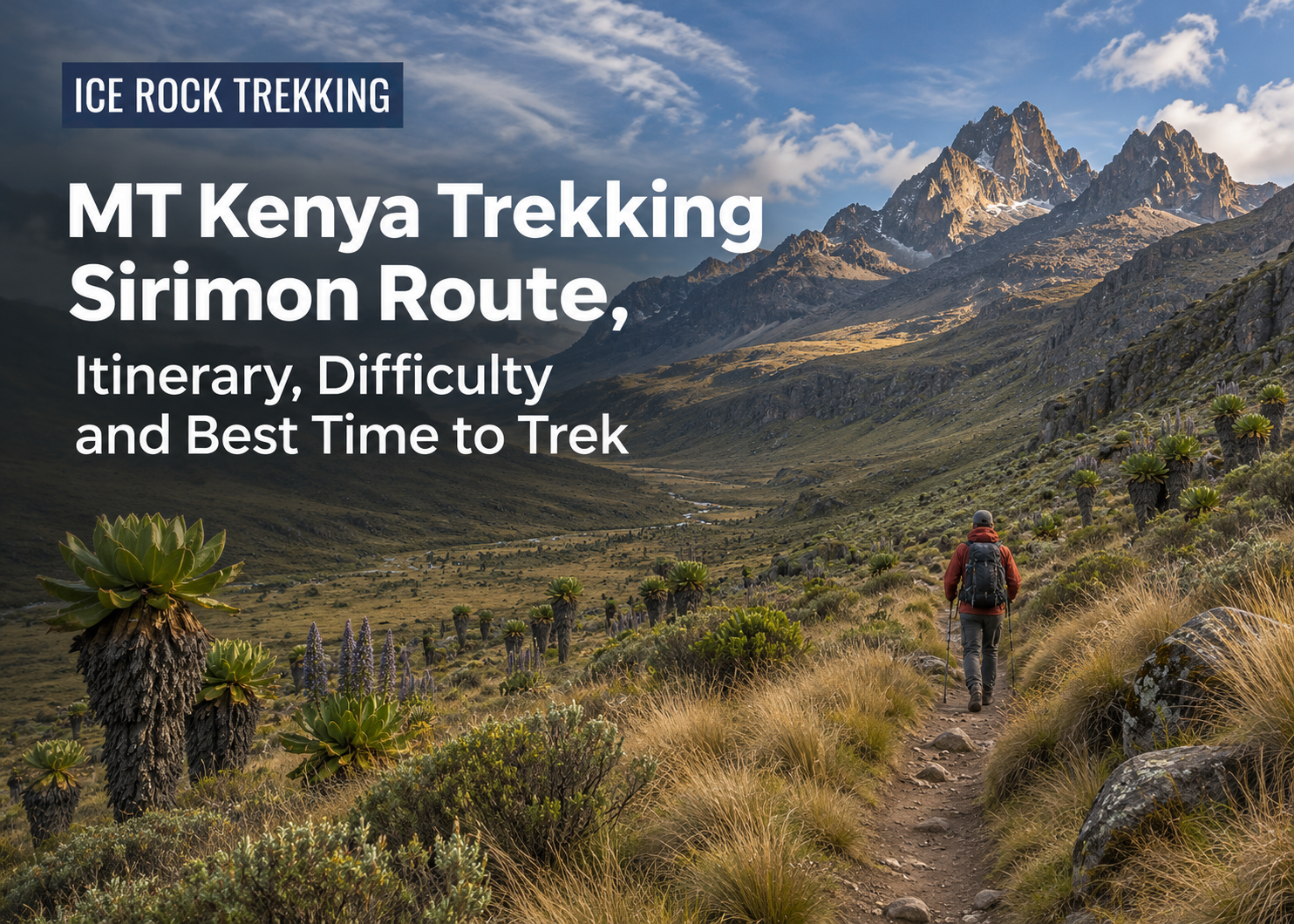
The mt kenya trekking sirimon route climbs through forest and open moorland on Mount Kenya’s north-western slopes before reaching the rocky approach to Point Lenana, at about 4,985 metres. Ice Rock Trekking’s five-day itinerary starts near Nanyuki and descends through Gorges Valley on the Chogoria side. January and February are generally the best months for drier conditions, with another favourable window from July to September. The approach is gradual in places, but the long climb to Shipton’s Camp and the steep, cold summit morning demand preparation.
Where does the Sirimon route start?
The trek starts at Sirimon Gate in Mount Kenya National Park, off the Nanyuki–Meru road. Kenya Wildlife Service places the gate roughly 200 km by road from Nairobi. Nanyuki makes a practical staging point if you prefer to arrive near the mountain the day before the walk. From the gate, the trail climbs through montane forest towards Old Moses Camp, where the vegetation opens up and the air feels noticeably cooler.
The scenery changes again above Old Moses. Moorland paths cross streams and ridges before reaching Mackinder Valley, where giant groundsels and lobelias punctuate the open terrain. Higher up, the vegetation thins and loose stone replaces the softer paths below. Point Lenana is the summit objective for the Sirimon trek. Mount Kenya’s two higher peaks, Batian and Nelion, require technical climbing. You can see their rock faces from the upper route when cloud lifts around Shipton’s Camp.
For photography, the walk into Mackinder Valley usually gives you more time to stop than the summit morning. Keep a camera within reach, but protect batteries from the cold overnight. Pause where the path is wide enough for others to pass, and keep to the marked trail around wet ground. The plants beside the streams are part of what makes this stretch distinctive.
Five-day Sirimon to Chogoria itinerary
Ice Rock Trekking’s published itinerary climbs from Sirimon Gate to Point Lenana and exits on the Chogoria side. The walking times below are estimates. Group pace, trail conditions and how people respond to the altitude can change the schedule. The overnight elevations matter just as much as the distances when deciding whether these stages suit your group.
| Day | Trekking stage | Approximate walking time | Overnight stop |
|---|---|---|---|
| 1 | Nairobi transfer, then Sirimon Gate to Old Moses Camp | Allow an afternoon for the walk | Old Moses Camp, 3,300 m |
| 2 | Old Moses Camp to Shipton’s Camp via Mackinder Valley | 6 hours | Shipton’s Camp, 4,250 m |
| 3 | Shipton’s Camp to Point Lenana, then down to Mintos | 4–6 hours | Mintos, around 4,250 m |
| 4 | Mintos to Meru Mount Kenya Bandas via Gorges Valley | 5 hours | Bandas, around 2,900 m |
| 5 | Walk through the forest to the pickup point and return to Nairobi | 3 hours | — |
Day 1. Sirimon Gate to Old Moses Camp
The first day combines a road transfer from Nairobi with roughly 10 km of uphill walking. The forest track gives you time to settle into a pace you can sustain across several days. Keep a rain layer accessible and leave enough time at camp to organise your kit before dark. Old Moses sits at approximately 3,300 metres, so where you slept in the days before arrival matters, especially if you are coming straight from sea level.
Day 2. Old Moses Camp to Shipton’s Camp
The route crosses streams and shoulders of moorland before entering Mackinder Valley. At roughly 16 km on the Ice Rock Trekking itinerary, this stage can feel long even for experienced walkers. The trail dips and climbs along the way, and Shipton’s Camp sits about 950 metres higher than Old Moses. Take the opening kilometres steadily. By the upper valley, you may find that a pace that felt comfortable lower down leaves you short of breath.
Day 3. Point Lenana summit and descent to Mintos
Ice Rock Trekking schedules a departure around 3 am for a sunrise attempt. A headtorch lights the path towards Harris Tarn, where the upper trail climbs over loose scree and rock. Progress slows on the steeper ground, especially if wind, frost or ice affects footing. Summit timing depends on conditions and how the group moves. After Point Lenana, descend towards Mintos on the Chogoria side and keep a warm layer handy for breaks.
Ask your trek leader what would trigger a change of plan on summit morning. A turnaround time leaves room to descend across the upper rocks before fatigue sets in or visibility drops. If the team turns back before Point Lenana, the exit route will depend on where you stop and the condition of the trails.
Day 4. Mintos to Meru Mount Kenya Bandas
The descent towards Gorges Valley passes terrain shaped by glaciers, with steep valley walls and views towards Lake Michaelson when visibility allows. The trail drops roughly 1,350 metres between Mintos and the bandas, so allow time for the downhill sections even when breathing feels easier. Poles can help with balance, particularly where the path is wet or uneven. Lower down, the walking gradually returns you to thicker vegetation.
Day 5. Forest walk and return to Nairobi
The last walking stage follows the bamboo and forest belt to the agreed vehicle pickup point. The published itinerary allows roughly three hours on foot before the return drive. Ask where the vehicle will meet you, since road conditions can affect how far it can go. If you have an onward flight, build in a buffer for the final walk, transfer and Nairobi traffic.
How difficult is the Mount Kenya Sirimon trek?
Sirimon is a strenuous high-altitude trek. The lower track has a manageable gradient, and the standard Point Lenana ascent usually involves hiking in suitable conditions. The challenge comes from several days on your feet, the jump in sleeping elevation between camps and the final climb on loose ground before dawn. Wind and cold can make simple tasks such as adjusting layers or eating take longer on summit morning.
If you are new to multi-day trekking, judge readiness by what you can do on consecutive days. Can you hike uphill for several hours with a daypack and come back the next morning for another long walk? Include controlled descents in your training, since a long downhill stage can tire legs that otherwise handle climbing well. Test your boots, socks and pack on uneven ground, including a walk in rain if you can. That gives you a chance to fix rubbing, slipping or awkward pack straps before the trip.
How much time should you allow to acclimatise?
The direct move from Old Moses to Shipton’s raises sleeping elevation by about 950 metres. The US Centers for Disease Control and Prevention advises limiting increases in sleeping elevation to about 500 metres per day once above 3,000 metres. The first night at Old Moses also deserves attention if your trip begins at low altitude. Discuss both stages with Ice Rock Trekking before booking. An intermediate overnight stop, where available and suitably placed, can help break up the climb to Shipton’s. Time at moderate elevation before entering the park can help you adjust before that first night.
Tell your trek leader promptly if you develop a headache with nausea, dizziness or unusual fatigue. Stay at the same sleeping elevation if you have symptoms of altitude illness and descend if they worsen. Confusion, difficulty walking straight or breathlessness at rest calls for urgent help and descent. Before departure, ask how the team would organise an accompanied descent if a trekker needed to turn back.
Best time to trek Mount Kenya via Sirimon
January and February generally offer the best odds of drier trails. July to September is another favourable period, with August and September worth considering if you need a second window. April and May typically fall within the long rains. The shorter rainy season generally runs from around late October into December, and the exact timing varies. Expect mud on the forest tracks and reduced visibility on the upper mountain during wetter spells.
Think about conditions on both sides of Mount Kenya if you plan to exit through Chogoria. Sirimon climbs from the drier north-west, and conditions can differ on the eastern descent and its access road. If you have flexibility, leave room in your holiday for a weather delay or a slower descent. Even in the drier months, carry waterproofs and insulation in your daypack. A clear afternoon at Old Moses can give way to a cold, windy morning higher up.
Should you descend via Chogoria or return via Sirimon?
Choose the Chogoria descent if you want to see a different side of Mount Kenya after Point Lenana. Gorges Valley, Lake Michaelson and the forest below the bandas give the return journey a character of its own. You finish at a different exit, so confirm that your booking includes a pickup on the Chogoria side. Ask how the operator handles the forest road if rain makes conditions difficult.
Returning via Sirimon takes you back through familiar terrain and simplifies transport if your group is based near Nanyuki. Some four-day return itineraries combine the summit attempt with the descent to Old Moses, putting much of the effort into a single day. When comparing four- and five-day trips, check where the extra day goes. An additional night before the summit can support acclimatisation, while an extra day after the summit gives you more time for the descent.
What to pack and check before booking
Pack for a wet forest approach, a cold camp and a summit start in darkness. Keep the items you may need during the walk in your daypack, even if porters carry your overnight gear. Access matters on the upper slopes, where stopping to reorganise a bag in the wind can leave you cold.
- Footwear and layers. Bring broken-in hiking boots with good grip, spare socks, a breathable base layer, insulation and a waterproof jacket and trousers.
- Summit kit. Pack a headtorch with spare batteries, warm gloves, a hat and a snack you can eat easily in the cold. Carry sunglasses and sunscreen for daylight hours.
- Camp kit. Check the sleeping bag’s comfort rating and confirm whether your booking includes a sleeping mat. Ask whether you will sleep in huts or tents and what changes if a hut is full.
- Water and food. Ask when the team supplies treated drinking water, how much to carry between stops and whether they can accommodate your dietary needs.
At camp, change out of damp clothing before it gets cold. Lay out your warm gloves, headtorch and early morning layers before bed.
Request a written breakdown covering park entry fees, camp or hut charges, transfers, meals and porter support. If you plan to hire equipment, check the size and availability in advance. Verify that your travel insurance covers trekking to about 5,000 metres and emergency evacuation from Mount Kenya. Some policies set a lower altitude limit, so check the wording against Point Lenana’s elevation before you travel.
For a private departure or group booking, share everyone’s recent hiking experience and any high-altitude trips when you enquire. That helps the team discuss a suitable pace and where to add a night. If participants arrive on different flights, agree on a meeting point and check whether anyone would go straight from a low-elevation arrival to the first high camp. Build the schedule around the people doing the walk, including whoever will need the most time to adjust.
Plan your Sirimon trek with Ice Rock Trekking
Choose your trekking dates, then compare the overnight stops and descent options before committing to a schedule. Ice Rock Trekking’s five-day Sirimon–Chogoria itinerary combines a north-west ascent to Point Lenana with a descent through Gorges Valley. Share your preferred dates, group size and previous altitude experience with Ice Rock Trekking to discuss the route, accommodation and whether to add acclimatisation time before the summit attempt.
FAQs
How many days does the Mount Kenya Sirimon trek take?
A Sirimon return trek can take four days. Ice Rock Trekking’s published Sirimon ascent and Chogoria descent takes five days, including transfers from and back to Nairobi. If you are arriving from low altitude, ask about spending an extra night before the summit and where that night fits into the ascent.
Is the Sirimon route suitable for first-time high-altitude trekkers?
Fit first-time high-altitude trekkers can attempt Sirimon with a gradual ascent plan and experienced trekking support. The standard route to Point Lenana is usually a hike in suitable conditions. The biggest challenges are the increase in sleeping elevation, sustained walking and the steep, rocky approach to the summit before dawn.
What is the best month for the Mount Kenya Sirimon route?
January and February are generally the best months for drier trekking conditions. July through September offers a second favourable window. Summit weather can change in any month, so pack for wind, rain and near-freezing or freezing conditions even if the lower trail is dry.