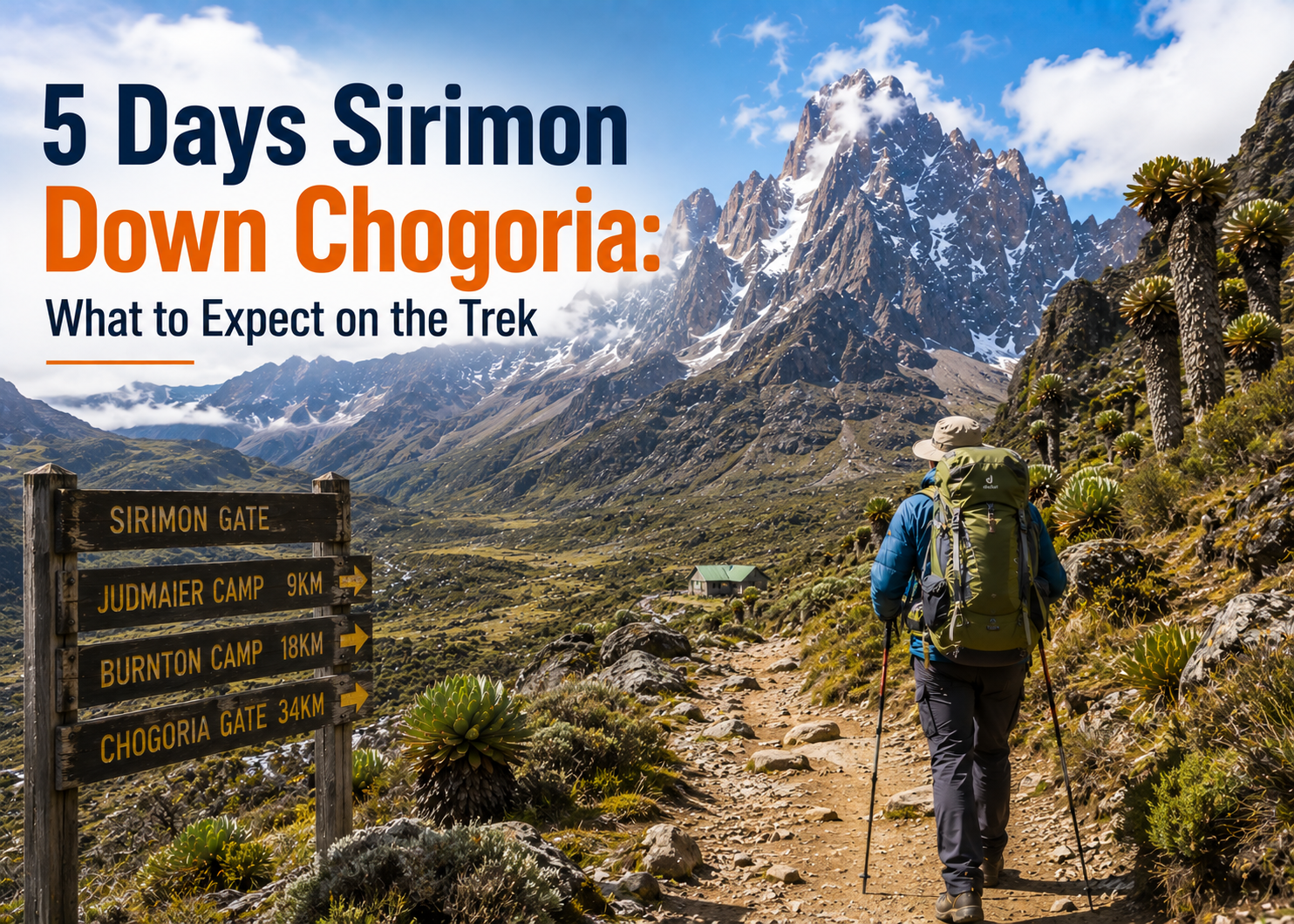
Mount Kenya rewards trekkers with far more than a summit moment. Its changing vegetation, broad valleys, unusual alpine plants, rugged peaks, glacial landscapes, lakes, waterfalls, and high-altitude camps create an experience that feels different at every stage.
The 5 Days sirimon down chogoria trek combines two contrasting sides of Mount Kenya. Trekkers climb through the more gradual Sirimon side, approach Point Lenana at 4,985 meters, and descend through the dramatic scenery of Chogoria. For trekkers seeking variety without retracing the same trail, this traverse offers a particularly rewarding way to experience the mountain.
Why Choose Sirimon Up and Chogoria Down?
Route selection can strongly influence the character of a Mount Kenya trek. Sirimon and Chogoria have different terrain, scenery, vegetation, and trekking conditions, which makes combining them an attractive choice.
The Sirimon Route provides a relatively gradual approach toward the higher elevations. The trek moves from forest into moorland before reaching the impressive Mackinder Valley and Shipton Camp. This progression allows trekkers to experience increasing altitude without beginning with an excessively aggressive climb.
Chogoria creates a striking contrast on the descent. Its lakes, cliffs, valleys, waterfalls, and greener mountain landscapes give trekkers something new to look forward to after reaching the summit area.
Instead of walking back through terrain already covered, trekkers cross Mount Kenya from one side to another. This makes the journey feel like a genuine mountain traverse rather than a simple climb and return.
What Makes the Five-Day Format Appealing?
Five days creates a practical balance between trekking time, altitude adjustment, summit ambitions, and sightseeing.
Mount Kenya should never be treated as an ordinary long-distance hike. Point Lenana reaches 4,985 meters, and the effects of altitude become increasingly important as trekkers move above 3,000 and 4,000 meters.
A five-day schedule provides more opportunity for the body to adapt than highly compressed itineraries. Some five-day variations include a dedicated acclimatization period around Shipton Camp, while others divide the journey differently after the summit.
Exact camp arrangements can therefore vary according to the operator, conditions, group ability, and chosen itinerary.
With Ice Rock Trekking, route planning considers the natural progression of the mountain and the need to maintain a manageable trekking rhythm.
Day 1: Sirimon Gate to Old Moses Camp
The first trekking day introduces climbers to Mount Kenya without immediately exposing them to its hardest terrain.
After reaching Sirimon Gate, the walking section begins through the lower mountain environment. The route gradually climbs through forest before moving toward heath and moorland vegetation.
Old Moses Camp sits at approximately 3,300 meters. Depending on the exact starting point and conditions, trekkers can expect roughly three to four hours of walking from the gate.
This first day is important because it establishes the pace for everything that follows. Strong trekkers may feel tempted to walk quickly, but maintaining a controlled pace is usually more sensible at altitude.
The landscape also begins changing noticeably. Dense vegetation gives way to more open terrain, and the scale of Mount Kenya becomes increasingly apparent.
For many visitors, the first evening at Old Moses is when the trek starts to feel like a true high-altitude expedition.
Temperatures can drop considerably after sunset, so warm layers become important even if daytime walking conditions feel comfortable.
Day 2: Old Moses Camp to Shipton Camp
The second day represents a significant increase in both distance and elevation.
Trekkers leave Old Moses and continue through increasingly open moorland. The route crosses mountain streams and passes through valleys before eventually entering the impressive Mackinder Valley.
This section is one of the defining parts of the Sirimon ascent.
Giant lobelias and other unusual high-altitude vegetation appear across the landscape. As elevation increases, trees largely disappear and the terrain becomes increasingly rugged.
The main peaks begin dominating the skyline.
Batian and Nelion create an imposing backdrop, while Point Lenana represents the trekking objective for most non-technical visitors. Batian and Nelion require technical mountaineering skills, whereas Point Lenana is the mountain’s principal trekking summit.
The journey from Old Moses to Shipton Camp generally takes around six to seven hours, although individual pace and weather can change walking times. Ice Rock Trekking lists Shipton Camp at approximately 4,250 meters on its Sirimon itinerary.
Reaching Shipton is a major milestone. At this elevation, trekkers often become much more aware of thinner air.
Simple activities may suddenly require greater effort. Walking to the dining area, organizing equipment, or climbing a small slope around camp can leave someone breathing noticeably harder.
That reaction reinforces an important mountain principle: fitness helps, but altitude affects everyone differently.
Day 3: Acclimatization Around Shipton Camp
Depending on the exact five-day itinerary selected, the third day may serve as an acclimatization period around Shipton Camp.
This should not be viewed as wasted time.
A well-planned acclimatization day can include a controlled hike to a higher elevation followed by a return to Shipton for another night. Some itineraries use areas around Hausberg Tarn, Nanyuki Tarn, Kami Hut, or nearby high points for acclimatization walks.
The purpose is straightforward: expose the body to a greater elevation while allowing recovery at a lower sleeping altitude.
Trekkers should continue drinking regularly, eating properly, resting, and monitoring how they feel.
This is also an excellent opportunity to enjoy the high mountain surroundings without concentrating entirely on covering distance.
Shipton Camp sits beneath Mount Kenya’s dramatic upper peaks. Rock formations, alpine vegetation, tarns, cliffs, and glacial features create a landscape that feels remarkably remote.
Trekkers can also use the afternoon to prepare summit equipment.
Headlamps should be checked, batteries organized, warm layers placed within easy reach, water prepared, and daypacks packed before sleeping.
The summit departure comes very early.
Day 4: Shipton Camp to Point Lenana and Down Chogoria
For most trekkers, this is the hardest and most memorable stage.
The summit attempt generally begins in darkness, often around 3:00 a.m. The reason for such an early departure is to reach Point Lenana around sunrise.
Walking before dawn introduces a completely different atmosphere.
The temperature is low, visibility is limited to the beam of a headlamp, and the rocky terrain requires concentration. At nearly 5,000 meters, even a controlled walking pace can feel demanding.
The final approach involves steep and rocky high-altitude terrain.
Rather than focusing constantly on the summit, trekkers often find it easier to concentrate on maintaining a slow rhythm: step, breathe, step, breathe.
Eventually, the horizon begins changing color.
Reaching Point Lenana at 4,985 meters provides expansive views across Mount Kenya’s upper landscape when conditions are clear. Batian and Nelion rise nearby, while ridges, valleys and distant plains spread out below.
After photographs and a short summit stop, the trek is far from finished.
The descent toward Chogoria begins.
Entering the Chogoria Side
One of the biggest advantages of descending through Chogoria is the dramatic change in scenery after the summit.
Instead of returning through Mackinder Valley, trekkers enter a landscape shaped by steep cliffs, deep valleys, lakes, rock formations, and waterfalls.
Depending on the selected trail variation, the descent can pass near features such as Hall Tarns, Mintos, Lake Michaelson, Gorges Valley, and other scenic areas associated with the Chogoria side.
Ice Rock Trekking’s itinerary, for example, describes a descent from Mintos toward Meru Mount Kenya Bandas through Gorges Valley via Lake Michaelson and Vivian Falls.
The visual contrast is striking.
Sirimon feels broad, open, and progressively alpine. Chogoria can feel more dramatic, with deeper valleys and water features creating strong contrasts against the mountain rock.
This is also why photographers frequently appreciate the traverse. New scenery continues appearing even after the main summit objective has been achieved.
Day 5: Descending Toward Chogoria
The final day takes trekkers farther away from the alpine environment and toward the lower slopes.
After several days surrounded by exposed high-altitude terrain, vegetation gradually becomes richer again.
The air also feels noticeably denser as elevation decreases.
For tired legs, downhill walking can still present a challenge. Long descents repeatedly load the knees, ankles, and quadriceps. Trekking poles can be particularly useful for controlling movement on uneven sections.
Depending on the itinerary, trekkers may pass Meru Mount Kenya Bandas before continuing toward the vehicle collection point or Chogoria side exit.
The final stage provides an opportunity to look back at how dramatically the environment has changed over five days.
Trekkers have moved from forest to moorland, into an alpine environment, close to the mountain’s highest peaks, and back through greener landscapes on another side of Mount Kenya.
That variety is one of the strongest qualities of the route.
How Difficult Is the Trek?
The Sirimon-Chogoria traverse does not require technical climbing skills when the objective is Point Lenana, but that does not make it easy.
Several factors create the challenge.
Altitude is the most important. Point Lenana stands at 4,985 meters, where oxygen availability is considerably lower than at sea level.
Trekkers also face long walking days, cold conditions, rocky surfaces, steep sections, and an early-morning summit attempt.
The descent can become physically tiring as well.
A reasonable fitness base therefore makes the experience considerably more manageable.
Trekkers should ideally prepare with regular walking, hiking, stair climbing, cardiovascular training, and lower-body strengthening before departure.
Training with a loaded daypack can also help prepare the shoulders and legs for consecutive trekking days.
What Weather Should Trekkers Expect?
Mount Kenya weather can change rapidly.
A morning may begin with clear skies and develop cloud, wind, mist, or precipitation later. Higher elevations can become extremely cold, especially during the night and before sunrise.
Trekkers should therefore prepare for multiple conditions rather than relying on a single forecast.
Layering works particularly well.
A moisture-managing base layer, insulating mid-layer, warm jacket, and waterproof outer shell allow trekkers to adjust clothing as temperatures change.
Gloves, warm headwear, suitable trekking socks, and reliable footwear become especially valuable during the summit attempt.
Sun protection is equally important.
Strong ultraviolet exposure at altitude means sunscreen, sunglasses, and protective headwear should remain accessible throughout the trek.
What Should You Pack?
Packing should focus on warmth, weather protection, comfort, and practicality.
Essential equipment generally includes sturdy trekking boots, trekking poles, waterproof clothing, thermal layers, warm gloves, a hat, sunglasses, headlamp, sleeping equipment suitable for low temperatures, reusable water containers, and a comfortable daypack.
Personal medication, basic toiletries, blister treatment, and high-energy snacks can also be useful.
Avoid packing unnecessary items simply because they might be convenient. Every additional item adds weight somewhere in the expedition system.
Ice Rock Trekking can help trekkers identify which equipment is essential and which items can be left behind.
Food and Hydration on the Mountain
Energy requirements increase during multi-day trekking.
Regular meals containing carbohydrates, protein, vegetables, and other energy-rich foods support recovery between walking stages. Appetite can sometimes decrease at higher elevations, but eating remains important.
Hydration deserves equal attention.
Cold conditions can make trekkers feel less thirsty even while they continue losing fluids through breathing and physical activity.
Carrying accessible drinking water encourages regular hydration rather than waiting until long rest stops.
Trekkers should also avoid relying exclusively on sugary snacks. Quick-energy foods have their place, particularly during demanding sections, but balanced meals provide more sustained support.
Altitude Awareness Matters
No responsible Mount Kenya itinerary should treat altitude casually.
Headache, unusual fatigue, nausea, poor appetite, dizziness, and disturbed sleep can occur after gaining elevation. Symptoms should always be communicated to the trek leader rather than hidden.
Walking slowly helps reduce unnecessary physical stress.
A trek is not a race.
The person walking fastest at Sirimon Gate is not necessarily the person who will feel strongest near Point Lenana.
Experienced mountain teams pay close attention to group condition, weather, pace, and individual responses as elevation increases.
Why Professional Trek Support Makes a Difference
A multi-day Mount Kenya trek involves much more than following a visible trail.
Route management, meals, camp logistics, porter coordination, water planning, weather decisions, pacing, and altitude observation all influence the quality of the experience.
Professional support becomes particularly valuable when conditions change.
Ice Rock Trekking focuses on organized Mount Kenya trekking experiences built around practical route planning and on-mountain support. The aim is not simply to move trekkers between camps but to create a structured progression across the mountain.
For first-time high-altitude trekkers, having an experienced team nearby can also make unfamiliar situations easier to manage.
Who Is This Trek Best Suited For?
This itinerary suits trekkers who want more than a quick summit attempt.
It works particularly well for active travelers who appreciate landscape variety, photographers seeking contrasting mountain environments, hiking enthusiasts progressing into high-altitude trekking, and experienced trekkers who want to see different sides of Mount Kenya.
The five-day format can also appeal to first-time Mount Kenya trekkers because Sirimon provides a relatively gradual approach before the traverse continues down the scenic Chogoria side.
However, anyone joining should arrive physically prepared.
Being comfortable walking for several hours on consecutive days is more important than having exceptional athletic ability.
What Makes the Route Memorable?
Some mountain trips become defined entirely by whether the summit was reached.
Mount Kenya offers much more.
The gradual climb through Sirimon, open Mackinder Valley, unusual giant vegetation, towering technical peaks above Shipton Camp, darkness of the summit push, sunrise from Point Lenana, and dramatic Chogoria descent all contribute separate memories.
The changing terrain also prevents the journey from feeling repetitive.
By the time trekkers reach the Chogoria side, the landscape can feel completely different from the environment where the trek began.
That sense of crossing the mountain rather than simply climbing it gives the route much of its character.
Responsible Trekking on Mount Kenya
Protecting the mountain should remain part of every trekking experience.
Trekkers should stay on established paths where required, avoid leaving waste, respect wildlife, minimize damage to vegetation, and follow park regulations.
Mount Kenya’s alpine ecosystems are particularly sensitive. Plants growing at high elevations may take many years to recover after being damaged.
Trekkers should also avoid disturbing animals for photographs or feeding wildlife around camps.
Responsible practices help preserve the environment for local communities and future visitors.
Preparing Mentally for Five Days on Mount Kenya
Physical preparation receives plenty of attention, but mindset matters as well.
Mountain conditions are rarely completely predictable.
Weather can alter views. Walking times can change. Cold mornings may make leaving a sleeping bag difficult. Altitude may force a slower pace than expected.
Trekkers who remain flexible generally adapt better.
Rather than expecting every hour to follow a rigid schedule, approach each day according to conditions and the recommendations of the mountain team.
Patience becomes especially important during the summit attempt.
Small, controlled steps often achieve more than bursts of speed followed by exhaustion.
Final Thoughts
The 5 Days sirimon down chogoria experience brings together many of Mount Kenya’s strongest trekking features within one continuous traverse. Sirimon provides the gradual ascent and impressive Mackinder Valley approach, Point Lenana delivers the high-altitude objective, and Chogoria rewards trekkers with lakes, valleys, cliffs, waterfalls, and changing vegetation on the descent.
For travelers who want a Mount Kenya trek built around scenery, physical challenge, altitude progression, and route variety, Ice Rock Trekking offers an itinerary that turns five demanding days into a memorable journey across one of East Africa’s great mountain landscapes.