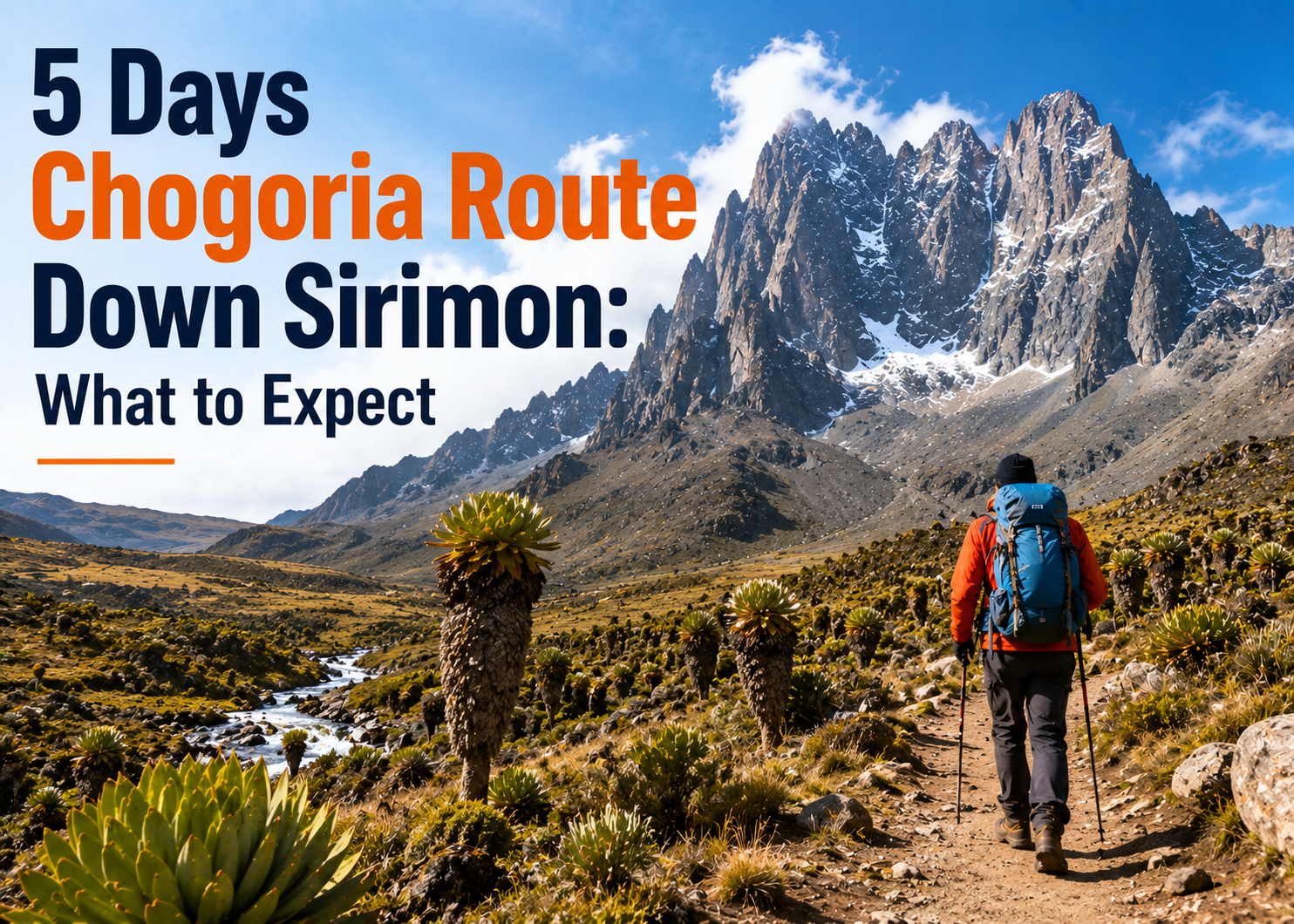
Mount Kenya rewards trekkers with rugged peaks, glacial valleys, high-altitude lakes, open moorlands, dense forests, and constantly changing mountain scenery. Among its most rewarding trekking combinations, the 5 Days Chogoria Route down Sirimon brings together two distinctly different sides of the mountain.
Starting from the scenic Chogoria side and descending through Sirimon creates a varied journey rather than retracing the same trail. For trekkers seeking dramatic landscapes, a challenging summit attempt, gradual acclimatization, and contrasting terrain, this five-day itinerary offers an exciting way to experience Mount Kenya.
Why Choose Chogoria Up and Sirimon Down?
Mount Kenya has several established trekking routes, but Chogoria is widely appreciated for its dramatic scenery. The trail passes through forests, moorlands, valleys, cliffs, waterfalls, lakes, and high-altitude terrain before reaching the upper mountain.
Sirimon offers a different experience. Its relatively open landscapes, broad valleys, and gradual descent make it an attractive route for leaving the mountain after the summit attempt.
Combining these routes allows trekkers to experience more scenery within one trip. Instead of climbing and descending through identical surroundings, the landscape continues changing from the first day until the final walk toward Sirimon Gate.
The route also provides excellent photographic opportunities. Lake Ellis, Lake Michaelson, the Gorges Valley, the high alpine zone, Point Lenana, and the Sirimon landscapes create a varied visual experience.
Quick Overview of the 5-Day Trek
A typical five-day Chogoria-to-Sirimon itinerary follows this general pattern:
Day 1: Chogoria area to Mount Meru Bandas
Day 2: Mount Meru Bandas to Lake Ellis
Day 3: Lake Ellis to Mintos Camp
Day 4: Mintos Camp to Point Lenana, then descend toward Shipton’s Camp
Day 5: Shipton’s Camp to Sirimon Gate
Exact camps, walking distances, departure times, and trail sections can vary according to weather, trekking conditions, group fitness, logistics, and the itinerary arranged by the trekking operator.
Ice Rock Trekking plans Mount Kenya trips with careful attention to pacing, mountain conditions, acclimatization, equipment, meals, and trekker safety.
Day 1: Chogoria to Mount Meru Bandas
The first day introduces trekkers to the greener lower slopes of Mount Kenya.
Depending on the trip arrangement, transportation may cover part of the approach toward the Chogoria side before trekking begins. The surroundings feature thick vegetation, forest scenery, and opportunities to observe the mountain’s lower ecological zones.
Mount Meru Bandas provides a comfortable starting point for the higher sections ahead.
This first stage gives trekkers time to settle into the rhythm of mountain travel. Rather than pushing aggressively toward higher elevations, a measured start allows the body to begin adapting while trekkers organize equipment and prepare mentally for longer trekking days.
Temperatures can become noticeably cooler as elevation increases. Keeping an insulating layer and waterproof jacket easily accessible helps trekkers respond quickly to changing conditions.
The first evening is also a good time to check boots, backpacks, hydration systems, trekking poles, and clothing arrangements before moving deeper into the mountain.
Day 2: Mount Meru Bandas to Lake Ellis
The second trekking day introduces one of the attractive features of the Chogoria side: Lake Ellis.
As trekkers leave the lower vegetation behind, the surroundings gradually open into moorland. Views become broader, and the character of the mountain changes considerably.
Lake Ellis sits in a beautiful highland setting and makes an impressive campsite for trekkers progressing toward Mount Kenya’s upper elevations.
The journey requires steady walking rather than unnecessary speed. Trekkers may already notice that breathing becomes different as altitude increases. A controlled pace, regular hydration, sufficient food intake, and proper rest become increasingly important.
Weather can change rapidly around the lake. Clear skies may give way to mist, rain, wind, or cold temperatures. Trekkers should therefore carry rain protection even when conditions appear favorable at the beginning of the day.
The evening at Lake Ellis provides a valuable opportunity for recovery before the more demanding climb toward Mintos Camp.
Day 3: Lake Ellis to Mintos Camp
Day three is usually one of the most memorable stages of the 5 Days Chogoria Route down Sirimon.
The landscape becomes increasingly rugged as trekkers move deeper into the high-altitude environment. Depending on the chosen trail, trekkers can experience impressive perspectives across the Gorges Valley and surrounding mountain formations.
Lake Michaelson is another striking feature associated with the Chogoria landscape. Its position beneath steep cliffs makes this section particularly appealing to photographers and mountain enthusiasts.
As the route approaches Mintos Camp, vegetation becomes sparse and the terrain feels increasingly alpine.
Altitude is now a major factor.
Trekkers should resist the temptation to move quickly simply because they feel strong. A slow, consistent pace conserves energy and supports adaptation to the thinner air.
Mintos Camp sits at a significant elevation and can become extremely cold after sunset. Wind may make temperatures feel even lower. Warm base layers, an insulated jacket, gloves, thermal clothing, and a suitable sleeping bag become essential equipment rather than optional comforts.
Dinner, hydration, and early rest are particularly important because the summit attempt normally begins during the night.
Day 4: Mintos Camp to Point Lenana
For many trekkers, summit morning becomes the emotional highlight of the journey.
The climb generally begins well before sunrise. Headlamps illuminate the trail while trekkers move carefully through cold, dark, high-altitude terrain.
Point Lenana stands at approximately 4,985 metres and is the primary trekking summit on Mount Kenya. Batian and Nelion rise higher, but reaching them requires technical mountaineering skills and specialist climbing equipment.
The final approach to Point Lenana can feel demanding because of the altitude, cold temperatures, darkness, and accumulated fatigue from previous days.
This is where controlled pacing becomes especially important.
Trekkers should focus on consistent movement rather than speed. Short, deliberate steps can help conserve energy during steeper sections.
Reaching Point Lenana around sunrise can reveal spectacular views across Mount Kenya’s rugged peaks, valleys, ridges, and surrounding highlands when weather conditions cooperate.
After spending a suitable amount of time at the summit, the group begins descending.
The descent toward Shipton’s Camp introduces trekkers to the Sirimon side of Mount Kenya. The change in scenery becomes immediately noticeable, adding another dimension to the trip.
After the intensity of summit morning, reaching camp gives trekkers an opportunity to eat, hydrate, rest, and reflect on the climb.
Day 5: Shipton’s Camp to Sirimon Gate
The final day involves a significant descent through the Sirimon landscape.
Trekkers leave the high alpine environment and gradually return toward moorland and lower elevations. As oxygen levels increase, many people find breathing easier and walking more comfortable.
The route commonly passes through the Old Moses area before continuing toward Sirimon Gate.
Although descending may appear easier than climbing, it still requires attention. Long downhill sections can place considerable stress on the knees, ankles, and quadriceps.
Trekking poles can be particularly useful during this stage.
As vegetation becomes thicker, the surroundings signal the approaching end of the mountain journey. Reaching Sirimon Gate marks the completion of a route that has crossed Mount Kenya from one side to another.
How Difficult Is the Trek?
This five-day itinerary requires good physical fitness.
It does not normally require technical climbing skills for Point Lenana, but trekkers should not confuse non-technical trekking with an easy mountain trip.
Several factors increase the difficulty.
Altitude represents the biggest challenge for many participants. Point Lenana reaches almost 5,000 metres, where reduced oxygen levels can noticeably affect physical performance.
Trekkers must also handle consecutive days of walking, uneven terrain, cold temperatures, early departures, and changing weather.
Summit morning adds another challenge because trekkers usually start in darkness after limited sleep.
Previous trekking experience can be helpful, although strong preparation, sensible pacing, suitable equipment, and proper acclimatization can make the route accessible to fit first-time high-altitude trekkers.
Acclimatization on the Route
Altitude deserves serious consideration on any Mount Kenya trek.
As elevation increases, atmospheric pressure falls and the body receives less oxygen with each breath. The body needs time to adjust.
Five days provides a structured progression through several elevation zones, but individual responses to altitude vary considerably.
Walking slowly can help reduce unnecessary physical stress. Trekkers should also drink sufficient fluids, eat regularly, and communicate openly with the trekking team about unusual symptoms.
Common altitude-related discomfort may include headache, tiredness, reduced appetite, disturbed sleep, or nausea.
Symptoms should never be hidden simply because someone wants to reach the summit.
Experienced mountain teams monitor trekkers and make decisions according to physical condition, weather, altitude response, and safety.
No summit is more important than a trekker’s wellbeing.
What Weather Should Trekkers Expect?
Mount Kenya’s weather can change quickly.
A morning may begin with clear skies before clouds, rain, mist, or strong winds develop later. Temperatures also vary dramatically according to altitude and time of day.
Lower sections can feel relatively mild, while camps at higher elevations may become extremely cold overnight.
Near Point Lenana, trekkers should prepare for freezing conditions, particularly during the pre-dawn summit climb.
Layering offers the most practical approach.
A moisture-managing base layer can sit beneath an insulating mid-layer and protective outer shell. Trekkers can then add or remove clothing as conditions and activity levels change.
Waterproof protection should remain accessible rather than buried at the bottom of a backpack.
Essential Clothing and Equipment
Suitable equipment can significantly affect comfort and performance during five days on Mount Kenya.
Trekkers should consider carrying:
- Waterproof trekking boots with good ankle support
- Moisture-wicking base layers
- Warm fleece or insulating mid-layers
- Insulated jacket for camps and summit morning
- Waterproof jacket and trousers
- Warm trekking trousers
- Thermal layers
- Warm hat and sun hat
- Insulated gloves
- Comfortable trekking socks
- Trekking poles
- Headlamp with spare batteries
- Sunglasses with strong UV protection
- Sunscreen and lip protection
- Reusable water bottles or hydration system
- Personal toiletries
- Suitable sleeping bag
- Small personal first-aid supplies
- Waterproof bags for clothing and electronics
Equipment should be tested before departure. A new pair of boots worn for the first time on Mount Kenya can quickly create blisters and unnecessary discomfort.
Physical Preparation Before the Trek
Training should focus on endurance rather than short bursts of intense activity.
Long walks, hiking, stair climbing, cycling, running, and cardiovascular training can help build stamina. Strength exercises for the legs and core can also improve stability across uneven terrain.
Trekkers should gradually increase training duration rather than making sudden changes shortly before departure.
Walking with a backpack during preparation can make training more relevant to actual trail conditions.
Hill training is especially useful because it prepares the legs for both sustained climbing and long descents.
Fitness cannot completely prevent altitude problems, but better conditioning allows trekkers to handle the physical workload more efficiently.
Food and Hydration on Mount Kenya
Trekking at altitude requires considerable energy.
Meals should provide sufficient carbohydrates, protein, and calories to support consecutive days of physical activity. Warm meals can also provide welcome comfort when temperatures fall at camp.
Appetite sometimes decreases at higher elevations, but trekkers should still try to maintain adequate food intake.
Hydration is equally important.
Cold weather can reduce the sensation of thirst even though the body continues losing fluids through breathing and physical activity. Carrying accessible drinking water encourages regular hydration throughout the day.
Ice Rock Trekking organizes trekking meals with the demands of mountain travel in mind, helping participants maintain energy across the itinerary.
Why Trekking Support Matters
A successful Mount Kenya trek involves far more than simply following a trail.
Route planning, permits, food, camping arrangements, equipment management, weather decisions, pacing, altitude awareness, porter coordination, and emergency procedures all contribute to the overall experience.
Professional trekking support allows participants to concentrate on walking, acclimatizing, resting, and enjoying the surroundings.
Local mountain teams also bring valuable familiarity with trail conditions and the practical challenges associated with changing weather and elevation.
Ice Rock Trekking works to create organized trekking experiences that balance adventure with responsible mountain practices.
Scenic Highlights Along the Journey
One major advantage of climbing through Chogoria and descending through Sirimon is the diversity of scenery.
The Chogoria side features dramatic valleys, lakes, cliffs, moorlands, and rugged geological formations.
Lake Ellis provides a peaceful high-altitude setting, while the Gorges Valley creates some of the route’s most impressive views. Higher sections reveal Mount Kenya’s sharp rocky formations and increasingly barren alpine terrain.
Point Lenana provides the summit experience before the route transitions toward Shipton’s Camp.
Sirimon then introduces broad valleys, open landscapes, moorland, and gradually returning vegetation.
The trek feels like a genuine crossing of the mountain rather than a simple ascent and return.
Responsible Trekking Practices
Mount Kenya’s ecosystems deserve careful protection.
Trekkers should avoid leaving litter, disturbing wildlife, damaging vegetation, or contaminating natural water sources.
Reusable bottles and properly managed waste can reduce environmental impact.
Staying on established trails also protects fragile vegetation, particularly in high-altitude environments where plant growth can be extremely slow.
Responsible trekking extends to local communities and mountain staff as well. Respectful interactions, fair treatment, and appreciation for the work of guides, cooks, and porters contribute to a more positive trekking culture.
Who Is This Route Best Suited For?
The route works particularly well for trekkers who want substantial scenic variety within a relatively compact itinerary.
It can suit physically active travelers, hiking enthusiasts, photographers, adventure groups, and trekkers seeking to reach Point Lenana.
Mountain professionals may also appreciate the route because it showcases several ecological zones and contrasting trail environments within one crossing.
People with limited hiking preparation should invest sufficient time in fitness before attempting the trek.
Those seeking a slower altitude progression may also consider a longer itinerary that provides additional acclimatization time.
What Makes the Five-Day Crossing Memorable?
The appeal of this itinerary comes from progression.
Trekkers begin among green forests before moving toward open moorlands, mountain lakes, dramatic valleys, rocky alpine terrain, and finally the summit zone.
After reaching Point Lenana, the landscape changes again during the Sirimon descent.
Each day therefore feels distinct.
There is also a strong sense of achievement in crossing from one side of Mount Kenya to another. The journey is not solely about standing at Point Lenana. Camps, changing landscapes, cold mornings, challenging climbs, shared meals, mountain silence, and long stretches of trail all become part of the experience.
Planning Your Trek With Ice Rock Trekking
Careful preparation can turn a demanding mountain itinerary into a rewarding adventure.
Ice Rock Trekking supports trekkers with route planning, mountain logistics, experienced personnel, accommodation arrangements, meals, and practical preparation information for Mount Kenya.
Before departure, participants should discuss their trekking background, fitness, equipment, itinerary expectations, and any concerns about high-altitude travel.
Packing early also gives trekkers enough time to replace unsuitable equipment rather than making last-minute compromises.
The mountain rewards patience. Walking steadily, respecting altitude, listening to the trekking team, eating properly, staying hydrated, and protecting yourself from changing weather can contribute significantly to a safer and more enjoyable experience.
Conclusion
The 5 Days Chogoria Route down Sirimon combines some of Mount Kenya’s most dramatic scenery with the challenge of reaching Point Lenana and completing a cross-mountain journey. From Lake Ellis and the rugged Chogoria landscape to summit sunrise and the broad Sirimon valleys, every stage offers something different.
With appropriate fitness, reliable equipment, careful acclimatization, and experienced trekking support from Ice Rock Trekking, this five-day route can deliver a demanding yet deeply rewarding Mount Kenya experience.